
All content across this site is and will remain AI free
By necessity, American football integrates all human body types in unison. Imagine all body politics across our world operating together like a great American football team and that we survive present multiple-simultaneous threats, turn future-emerging threats into opportunities and thrive for millennia.
In the complex social makeup of the United States, football can and does unite. The all-critical concussion issue can be dealt with in my view with specific changes in tackling techniques that can make the game even more dynamic, addressed in part at the end of this article.
Terms such as “human team,” “human family” and “ human cause” are useful but they can be rightly criticized as monolithic, melting away specific cultures and human individuality, regardless of intent. Beyond using such rhetorical terms to convey mere solidarity of purpose, what if we as eight billion humans became an actual team of teams, as in offense, defense and special teams? Not just any big team but the kind of team on which every human across our globe and eventually beyond maximizes individual and collective potential in true synergy of purpose — ensuring multi-generational survival through multi-world, multi-moon and multi-space station human expansion. In such a new context:
“Where else would you rather be than right here, right now?” Marv Levy (born 1925), Head Coach, Buffalo Bills (1986–97) of the National Football League (United States) — pre-kickoff phrase originated as Assistant Coach, University of New Mexico Lobos (1954–58).
I’m not suggesting that Coach Levy, a trained historian and sports novelist would agree with the above multi-planetary proposition or not. I’m only appropriating it for this global audience online to consider. In any case, Levy is one of two handfuls of coaches for whom I most would have liked to play or assist at any level, particularly when he coached the Montreal Alouettes from 1973–77 in the more wide open Canadian Football League (CFL), also defined as [North] American football.
One of those other coaches, in the National Football League (NFL), George Allen (1918–1990), Head Coach, Washington Redskins (1971–77)— name discontinued on July 13, 2020 in favor of “Football Team,” is famous for his own pre-kickoff phrase:
“40 men together can’t lose!” Tweak: Eight billion together will not fail.
[Note that Levy and Allen coached together with the Philadelphia Eagles in 1969, the Los Angeles Rams in 1970 and in Washington from 1971–72 with quarterback and eventual Cincinnati Bengals head coach from 1984–91, Sam Wyche (1945–2020), discussed later.]
Initial mental expansion — the decade 1978–88: My early years from ages five to 15 were filled with travel to 18 countries and multi-ethnic athletic experiences across six sports in Ohio, all at fairly intense levels given the tradition of excellence in the region. (I’m #7 in the title image of this article.) The town in which I was raised, Yellow Springs, Ohio is home to Antioch College (Founded 1852) which beginning with the presidency of Arthur Morgan became known nationally for promoting progressive values and practical innovations within higher education. Yellow Springs can be close-knit as well as live-and-let-live, the latter of which is why my parents relocated there from Cincinnati, perhaps the most conservative city in the United States. Aspects of both communities are in my personal makeup but more so aspects of the region, Southwestern Ohio — distinct topographically, historically and culturally.
Before playing any sport, at age five in 1978, I recall feeling embarrassed and depressed by what I can describe now as indirect corporate advantage while sitting in the TWA (1930–2001), Trans World Airlines, Inc. departure terminal at the Cincinnati/Northern Kentucky International Airport (CVG) with my maternal grandparents, waiting to start my first trip abroad. My maternal grandfather (1915–2009) had retired in 1976 from Procter & Gamble as an industrial/chemical engineer. He had designed the standardized factory model for producing Tide detergent around our world before supply chains emerged as we know them today. In the process, he and my maternal grandmother (1917–2015) were bitten by the travel bug. My mom (born 1942), my older half-Greek half-brother (born 1963), my aunt (born 1939) and her five multilingual children (born 1960 to 1965), all benefited in incalculable ways from their example of gaining insight through travel.
My grandparents were not as wealthy as you might expect. Procter & Gamble made sure of that. They were upper-middle class due to my grandfather’s Massachusetts-bred Yankee thrift, including during these trips. For example, over Christmas 1987 break at age 15, heeding my grandfather’s penny-pinching manner coupled with the bit of cash that my grandmother had transferred from his wallet to mine, I became dehydrated on safari in Kenya and Tanzania from not drinking enough bottled water which was more expensive than canned soft drinks — ideal human dehydrators. I narrowly avoiding being hospitalized in Nairobi, exclaiming according to my grandmother’s good long-term memory, “this is no vacation, it’s an adventure,” to which my grandparents nodded in familiar approval.
Back to CVG 1978. Perhaps because of this inherited frugality or from other subtle and not so subtle cues, I was concerned by how much money my grandfather was spending for my plane ticket alone that might otherwise be used to help poor people, black and white, whom I had seen during drives through Cincinnati. Why did I get to fly and they didn’t?
Still, I had been deeply impressed with the three yellow baseball-sized dots on the automatic glass doors leading to the ticket counter. To me, I was in the future after passing through those dots and the airplane was going to take us farther into it. Real world destination: The United Kingdom, the first of three trips to The Mother Country of the United States. Years later, I would learn that poor people exist in the United Kingdom as well, in addition to the concept of the Anglo-sphere across our world.
Most of these trips were in effect, diplomatic fact-finding missions at the citizen level. I believe that if such visits were made available to every person who wants them, even just one trip sponsored by an airline consortium, financial institution, hotel chain or all three, human teamwork could be better initiated and sustained for generations, across many worlds. If human extinction happens, at least let us not wish that we “could’ve, would’ve, should’ve” tried harder to become a really good team to avoid such a fate.
The aesthetic fulfillment that was watching and playing American football from 1980–93 had elements of what I thought future years such as 2020, 2025 and 2030 might hold if we as the United States won the moral peace with the Soviet Union, turned Russian Federation (1991-present). This impression or gut feeling owes much to the inspiring crisp and orderly architecture of the Astrodome (1965–2008), home of the Houston Oilers and Texas Stadium (1971–2010), home of the Dallas Cowboys. This futuristic sense was enhanced by slow motion videography of high and far-thrown balls — “bombs” spiraling toward gifted receivers and defensive backs attacking those bombs akin to President Ronald Reagan’s proposed Strategic Defense Initiative (SDI), accompanied by equally gifted commentary by “The Voice of God,” John Facenda (1913–1984) as part of NFL Films, co-founded by Ed Sabol (1916–2015) and his son, Steve Sabol (1942–2012) — distinct from the NFL itself. Then and in reality still, ever-changing probabilities of auto nuclear annihilation had been the backdrop to human life since the 1950s, into which I was born in late 1972, the same week as the return of Apollo 17 and the painful long pause of actual human trans-world exploration for over 48 years into present day.
At the impetus of my worldly maternal grandmother, an opportunity to visit Finland, the Soviet Union and Mongolia in Summer 1986 informed my perspective of sports, this multinational trip coming weeks after the April 26 Chernobyl nuclear power plant meltdown, our travel having been planned before that seminal event took place. Before leaving for Helsinki, I was in the lead to become “Home Run King” in my hometown’s Little League and had qualified for The Athletics Congress (USA Track & Field since 1993) Junior Olympic National Championships as a member of the 4×800 meter/two mile relay team for the Miami Valley Track Club from Dayton, Ohio. In that moment without realizing it, through my choice at age 13 to visit these three nations and my dad’s insistence that I go as a self-appointed youth ambassador and not a tourist, I re-calibrated my highest internal priority from sports achievement to positive global inter-connectivity, rightly or wrongly on a personal level. Of course, in the global Olympic tradition, sports and global peace are intertwined. This occurred to me as I trotted around the track at Helsingen Olympiastadion (Helsinki Olympic Stadium), considered an architectural masterpiece and the feature site of the 1952 Olympic Games, a welcome surprise stop on our city tour and chance for me to fight off some tour bus-induced vertigo. During the post-war years, my dad (1919–2007) had been a letter-writing proponent to the U.S. Department of State and local organizer in Cincinnati of the concept that led to President Eisenhower’s Sister Cities International initiative that lasts to this day, “the best thing I ever did” he occasionally remarked over the 34 years that our lives on Earth overlapped.
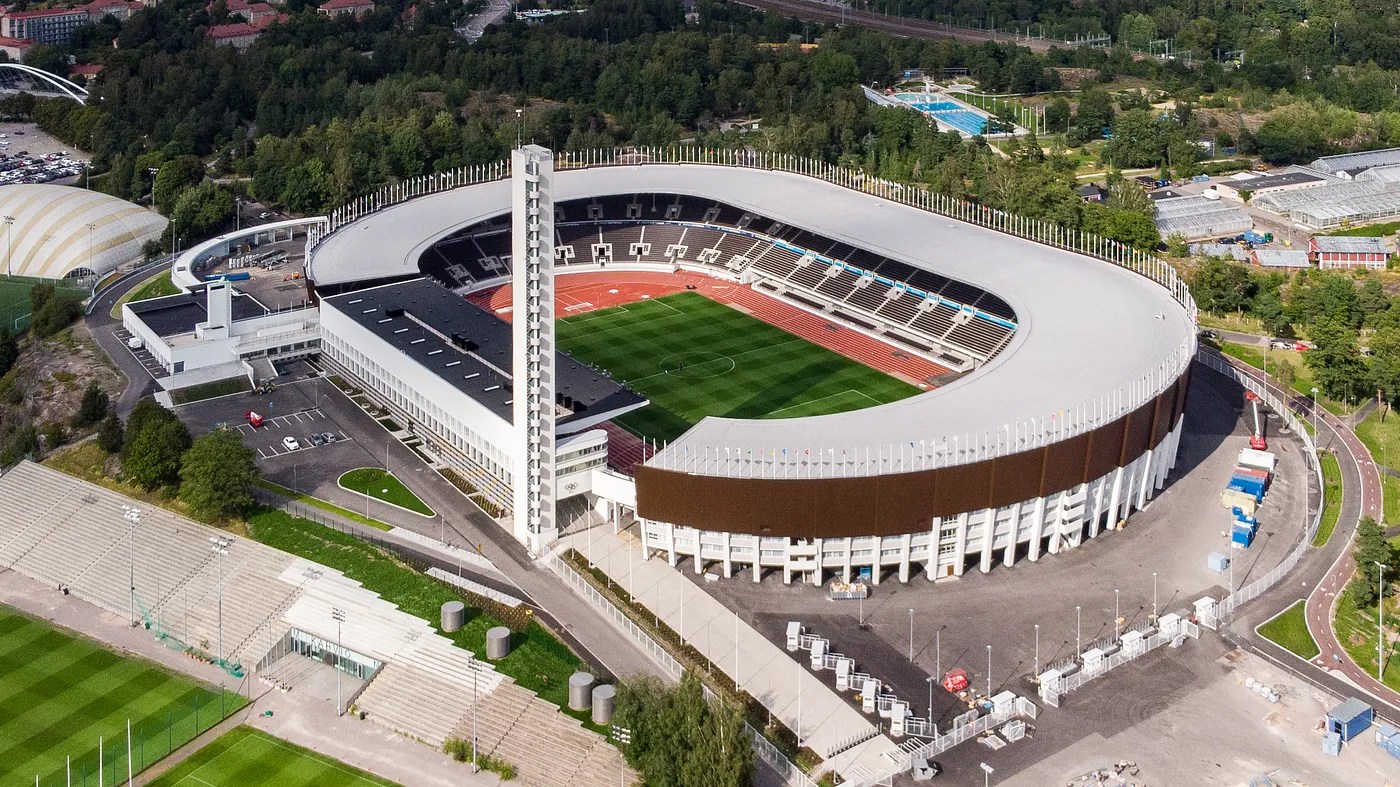
Except for a few intense years (2002 to 2006) in and around Washington, D.C. space policy research and various issue advocacy groups, I followed and continue to follow American football from a distance. Once, I closed that distance by working as an academic tutor-mentor with the 2007 University of Hawaii Warriors Sugar Bowl team in my first year as a Ph.D. student in political science (international relations). How could I not?

Back to 1986. Any football field that I saw anywhere, including in the slick pages of pre-internet Sports Illustrated brought visual serenity through the long crisp sidelines, inviting end zones demarcated by bright Tang-orange pylons and sure-fast enhanced rich green turf, both natural and artificial. Back then, AstroTurf was bright uniform green (as it should be) without trying to mimic enhanced natural grass and I saw that as futuristic — 2020s-ish. When lucky enough to stay at the old “Holidome” properties by Holiday Inn during domestic trips with my maternal grandparents every other summer, the put-put golf surfaces became pleasing on-camera end zones in my mind, prime ready to be tip-toed into for a touchdown, suitcase in hand.
Upon return from interacting with Soviet teens at an outdoor community dance in Irkutsk, Siberia and seeing the open field expanses of Eurasia by plane, train and tour bus, training camp for my eighth grade football season with the Morgan Middle School Bulldogs in Yellow Springs began in early August 1986. I was incredibly lucky to be instructed by a father and son-in-law coaching “staff,” one Irish-American and one African-American, both having played college football as attack-oriented defensive backs for the Illinois State University Redbirds and the University of Iowa Hawkeyes respectively. They made me our team’s tailback on offense, left cornerback on defense, punter on special teams and showed me basic offensive and defensive formations and footwork in these positions and other aspects of the game, especially in regard to injury prevention of ourselves and our opponents.
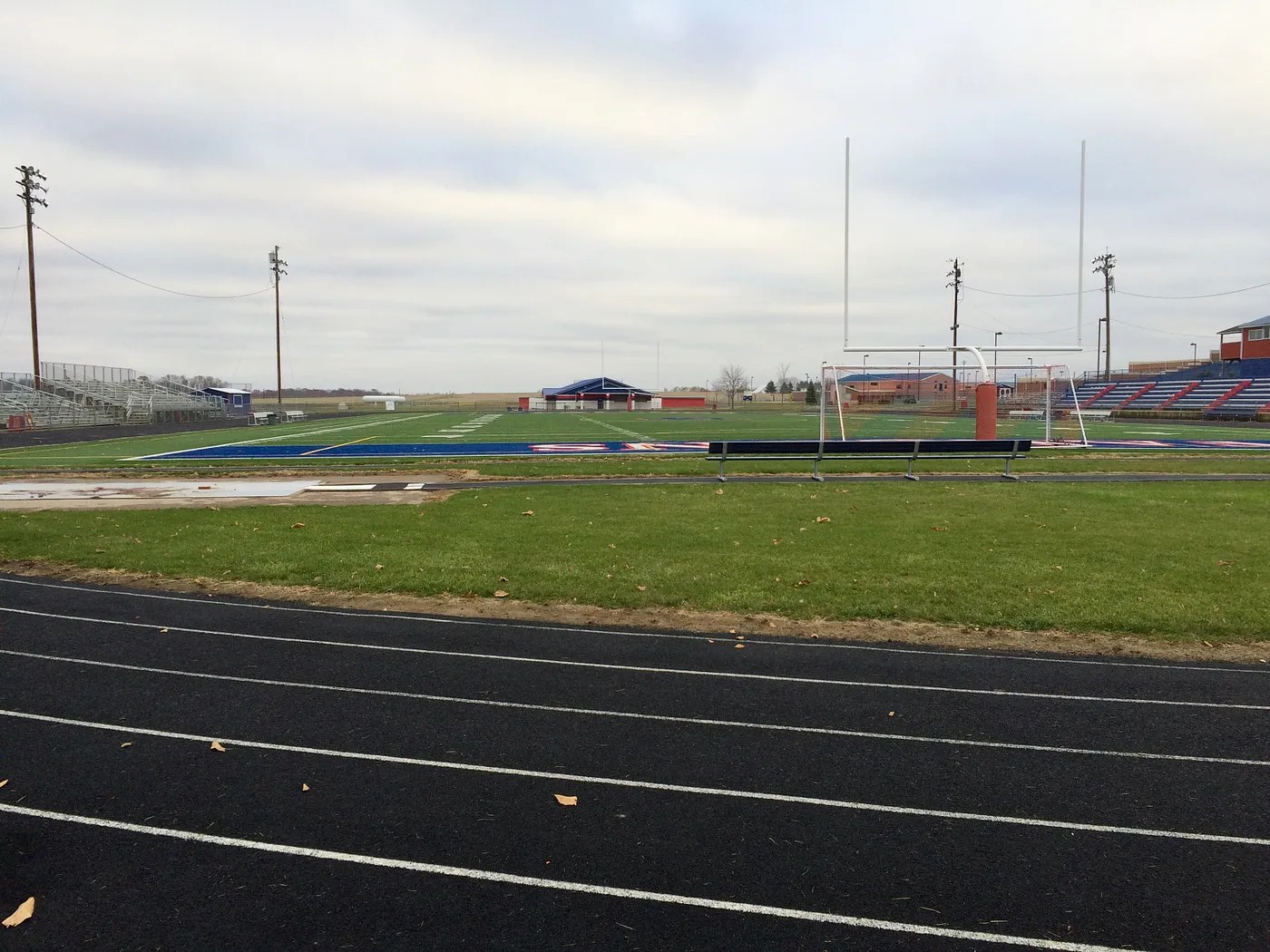
Through a family friend, I had also received free punting lessons in Summer 1984 from a former Ohio State University Buckeye punter from the late 1930s on a real college football field northeast of Cincinnati, that of the Wilmington College Quakers in Wilmington, Ohio — pictured below. (The Quakers had made it to the NAIA Division II Championship in 1980 and the playoffs in 1982 and 1983.) These lessons on technique added much initial guidance on field position objectives from my dad that he had exploited as a punter/receiver (end) for the Walnut Hills High School Eagles in Cincinnati during the mid-1930s. This late 1930s Buckeye punter simply put orange cones on the sideline at the ten yard line, five yard line and goal line and had three of us take turns punting from the 50 yard line, aiming for just inside the five yard line cone, even if from a series of bounces which over time became somewhat predictable. This expert-supervised training would also aid me later as a kick returner in high school. Our personal 67-year-old Buckeye quietly showed us how to punt Ohio style and we took turns imitating him non-stop for an hour or so. That’s coaching. The actual “Coffin Corner” and field at which this expert punting instruction was performed, though the surface used to be enhanced natural turf:

In addition to various ball reaction drills, including “The Tip Drill” (inspiration for my website name — 3x3globaldrills.com), our 26-year-old former Hawkeye who had played his high school football in Jamestown, two small towns southeast of Yellow Springs had us run long unmarked wind sprints at the end of practice, at dusk when it was relatively cool. His older cousin from the same small town had played defensive back in the Super Bowl several months earlier against the 1985 Bears, among other NFL and college football exploits. (Names of coaches and players who are not public figures with whom I played are withheld at this point for their privacy and because they may not wish to be associated with ideas and agendas I present here.)
Our team started the season with about 14 to 17 players and ended the season with our only win coming on Halloween night with 11 players, the minimum required to play American football. A few teammates had chosen trick-or-treating over what to them was to be another close loss on the road. The setting for our upset victory happened to be a football battlefield surrounded by cornfields somewhere between Cincinnati and Columbus, ten miles west from the purposely remote former Cincinnati Bengals training camp at Wilmington College, the same site of my punting lessons shown above.
Paul Brown (1908–1991) who coached football during World War II as head coach of both the Ohio State University Buckeyes (1941–43) and the Great Lakes Naval Training Station Bluejackets in Chicago (1944-45) before founding and coaching both the Cleveland Browns (1946–63) and Cincinnati Bengals (1968–75) had selected Wilmington as the Bengals’ training camp site in 1968, lasting past his death to 1996. Brown had also played quarterback for the Miami University Redskins (renamed RedHawks in 1998) in Oxford, Ohio in 1927 and 1928, northwest of Cincinnati near the Indiana border. Six years later in 1992, as a one year sophomore transfer student-athlete, without knowing this history, I had the Love and Honor (Miami University’s informal motto) as a walk-on to workout with the Miami Redskins receiving corps and offensive coaching staff as a developmental roster member before, during and after a 6–4–1 season — essentially a participant-observer of 1990s mid-major NCAA Division 1-A football for this article.
On a frigid winter day during the 1992–1993 off-season, I “hung up the cleats” in order to salvage the last half of my undergraduate education beyond “getting good grades,” which for a variety of reasons were also suffering. This major change in plans involved flying to London for an academically traditional junior semester and intership abroad before returning to my first university (University of Dayton), this time as a commuter student living alone just off campus, as I preferred. While both agonizing over and being grateful for these options, a stranger pulled his car up beside me as I was pacing out the driveway of Yager Stadium just north of campus. The stranger was Coach Lou Holtz (born 1937) of the University of Notre Dame Fighting Irish (1986–1996) offering me a ride home and to get out of the cold, the kind of cold that bites human bones. Holtz was pretty much the most famous and personally dynamic college football coach in the United States during that era. Coach Joe Paterno (1926–2012) of the Pennsylvania State University Nittany Lions and Coach Bobby Bowden (born 1929) of the Florida State University Seminoles may have rounded out the college coaching fame triumvirate at that point in space-time, at least in my mind.
Holtz was on campus as a guest speaker for that evening and had stopped by the football offices to check in on our head coach, Randy Walker (1954–2006) who had contributed and would contribute much to the college game as a player at Miami of Ohio (1973–75) and as head coach of the Northwestern University Wildcats in Chicago before his premature death at 52 in 2006. To witness camaraderie indirectly like that among college coaches, great and aspiring alike was a life lesson learned. Our world could use more of that.
Coach Holtz and I chatted briefly during the mile to the curb of my apartment about a game that I had remembered seeing him win on TV when he coached the University of Minnesota Golden Gophers in 1984 and 1985. As events had unfolded, Minnesota was the one other NCAA Division 1-A team for which I had had a viable invitation to walk on after attending their football camp in Summer 1990. I declined based on a false and unchallenged perception/myth of 500:1 student-teacher ratios in all classes and because it didn’t seem like the Gophers had any specific intermediate role for me to play, just to workout hard with the team and see what happens, such as taking away a hard-earned and likely needed athletic scholarship from an unexpectedly befriended teammate. This was also the Darwinian situation that might have occurred at Miami of Ohio had I stayed with the Redskins, so I thought.
A year and a half earlier, during my first week of college at Dayton, I had been inspired to really maximize my intellectual potential by spending extra time in the library and at the keyboard instead of in the weight and film rooms. This inspiration came from University of Dayton history professor, Lawrence Flockerzie, who as it happens had been an excellent high school football player in Boston, as I recall from pictures he showed me in his office. In his Fall 1991 course on Western Civilization, Flockerzie put our human history-present-future into broader context — it being clear by then that the Cold War was ending or had de facto ended with the beginning of a new period if not epoch of history beginning, up to us to define during the next 10–20 years.
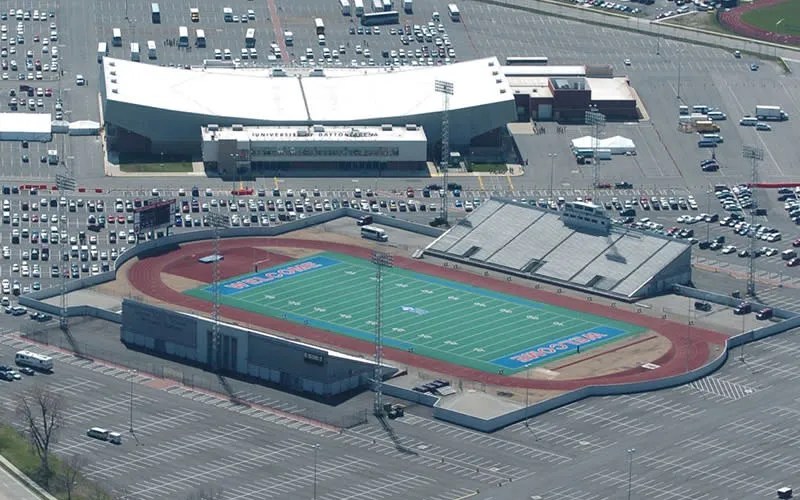
Even before classes began at Dayton, the short-lived coup of Gorbachev during our training camp in August 1991 on the dehydrating and turf-toe-causing AstroTurf of “Welcome Stadium” began to take the gleam out of my wide-out football eyes. I was beginning to feel that I should be preparing to help bring about good things to follow, with or without the tools that we have inherited from the nation-state system hierarchy, including scarcity-based money and exchange as we know it.

In February 1991, during one of the final days of the first Gulf War in my final semester of high school, I had visited Coach Gary Etcheverry (born 1956), one of the least famous head coaches in college football at the time, then in his second of four years leading the Macalester College Scots in Saint Paul, Minnesota, just up the Mississippi River from the Golden Gophers’ practice facility where I had attended camp in Summer 1990. From 1974–1980, Macalester was literally the worst college football team in the nation but Etcheverry persuasively explained his novel defensive philosophy to me and my dad in his office as part of his appeal for me to only play defensive back as a featured part of building his program/system. Coach Etcheverry, who kept it secret in our meeting that he had been a special teams coach for the Los Angeles Rams in 1988, my sophomore year in high school playing starting quarterback, running back, all special teams and safety on defense. “Etch” as he has been referred to by a fellow coach and former CFL player would later make his mark as a path-breaking defensive coordinator with five teams in the Canadian Football League, as Head Coach of the Toronto Argonauts (2002) and winning the 85th Grey Cup with them in 1997 as Defensive Line Coach.
Without ever hearing of Macalester or understanding how truly great of a globally-oriented undergraduate liberal arts college it was and is, as this claim was and is made by most NCAA Division III colleges, usually minus the global dimension, I politely and sadly declined Etch’s offer by phone upon return to Ohio. I knew that his plan for me to only play defensive back was a vote of his confidence in my ability to defend other wide receivers. Despite enjoying playing defensive back under the continued tutelage of my 8th grade father and son-in-law college defensive back coaching duo as my way of staying physically loose and psychologically involved in the intensity of the game when not on offense and special teams, my just-turned 18-year-old self needed to explore playing wide receiver in college. After all, this was the position that I had excelled in during my last two years of high school, receiving my share of records and awards. This I did but as a practice player, unknowingly gaining insight through osmosis of different ways to successfully lead human teams from two of the most traditional and frankly boring balanced offensive programs in the country, “confidently”/arrogantly thinking that these systems would adapt to my talent, if for no other reason than to surprise the competition.
I didn’t understand until after the recruiting process was over that my high school receiving yardage, floating between first and second highest in the Dayton, Ohio area for all size schools as a junior was discounted by larger university recruiters due to my school playing at the lowest level of the Ohio high school ranks. That I was a National Honor Society student, though not a National Merit Semifinalist was icing on the cake for small academically elite schools like Macalester looking to improve their football reputation which never hurts in maintaining alumni donations.
All I knew is that everyone else knew based on local newspaper rankings is that I did everything I could, even making a winning catch as a senior in overtime against a large but low-ranked high school that unwisely scheduled our low-ranked small school team for their homecoming. Like life, along with camaraderie, football can also be a game of moral victories, individual and team. About once a month during football season, my dad would say of a player making a great play on TV, “he’ll remember that one for the rest of his life.” That’s true at all levels of play in any sport, good plays and bad and is a reason to play at any level between the lines for the head coach as opposed to the offensive coordinator that a player knows intuitively most wants him or her to play right away, no matter the position and regardless of stadium size and program prestige.

In Fall 1990, I had become part of a special teams trio as our placekick holder for our long-snapper/right offensive tackle and our placekicker/punter who primarily played soccer and tennis for our high school. This kicker/punter/tennis star would placekick and play tennis for the NCAA Division 1-AA East Tennessee State University Buccaneers. All three of us had received the same casual recruiting letter from one of the seven mid-major NCAA 1-A schools in Ohio, inviting us to a game free of charge by showing up at the will call booth on game day. Together, we drove across state one Saturday morning, hours after our game on a Friday night. As we neared the stadium, we saw what appeared to be parents of African-American players picketing the game, carrying signs indicating that NCAA Division 1-A (FBS since 2006) student-athletes were economically exploited — not a good look and not a good feel as us three white guys rolled into a parking spot. This issue has matured and can be read about elsewhere in the present.
That picket led me to question the ethics of that particular university, at which I knew a European-American red-shirted wide receiver from having played with him at another area high school during my first year when he was a promising sophomore running back. Driving home, I also began to question the whole recruiting and institutional superstructures I sensed were undermining the spirit of the actual game between the lines for which we as players from all ethnicity knowingly yet compulsively risked and continue to risk the quality of the rest of our lives if not our actual lives on every play. For what exactly? Perhaps beyond team camaraderie, primal crowd roars are more seductive than we realize, even small crowd cheers. Such positive community camaraderie is coupled with community entertainment, masking dark political pacification of populations and financial solidification of alumni network at all levels. Within the lines of individual games, exhibition of combined human spirit among players and sometimes among players and coaches is inspirational, precisely because dark surrounds light.

The takeaway from my experience as a tutor-mentor across many sports at the University of Hawaii (2007–2008), a major FBS team is that scholarship athletes are not receiving the economically transferable value of their scholarships. While there may be time to complete assignments and even receive good grades, there is no time to reflect deeply on and absorb practical material much less unanswered universal questions being taught-introduced at the undergraduate level. This system defect could be remedied by athletes not attending class for credit during the season of their sport, usually a semester and receiving tuition vouchers with no expiration date, to be redeemed after or during a short-lived professional career, in one of the arena football leagues for example. Depending on the situation, athletes might also be encouraged to audit courses during their sports seasons. Such a measure would benefit athletes, coaches, game-watching alumni, professors and most-importantly, the general student body by eliminating preferential academic treatment of athlete-students, a process that begins with undue social promotion in high school, where remedial education should take place, not at the collegiate level. This ongoing practice is undermining academic camaraderie in colleges and universities, negatively affecting society as a whole which includes global society given increased international student bodies since the 1990s.
As a high school age citizen, evaluating a college or university to maximize opportunities for developing student-athletes or athlete-students to thrive is as much art as science — even more so pre-internet given the lack of instantaneously available information for students and parents/guardians to discuss from a know and trust thy self basis. In the decades since the 1990s, awareness at the world level has been codified on preventing underage athletes in all sports from being exploited economically, abused sexually and neglected physically, intellectually and psychologically. UNICEF UK has a succinct statement of principles, Safeguarding in Sport, worthy of consideration and adoption or adaptation by university and professional sports associations or leagues as well.
At the end of the Fall 1985 season, my first year playing football in 7th grade, our African-American head coach apologized to me for only having thrown my direction one other time the whole season right after the last play of our last game in a losing effort in a win-less season. This coach constantly stressed football as complementary to academics, having been an assistant with the Central State University Marauders, a historically black university and NCAA Division II powerhouse at the time, seven miles southeast of Yellow Springs. I had just made a diving catch on a 15-yard out-route, just south of our home bleachers, keeping both feet in bounds as I fell to the sideline for a first down with no time left on the clock. A faint cheer could be detected from the peeling blue-painted wooden bleachers.
The game was out of reach so the throw was a gift by our graduating eighth grade quarterback, a black guy with whom I had played select youth soccer, also with his twin brother for our town’s winning traveling team, the Rangers in 1982 and 1983. “The Twins,” so nicknamed by our Kenny Stabler-looking/John Madden-acting player-oriented coach and I, “Schwaben” had been three of our team’s four strikers, coached to relentlessly follow through on secondary and tertiary shots on goal. The other twin was one of our running backs in this last game that we would all play together as bounding youth.
My out-route to the left was supposed to be a diversion to clear space for a taller eighth grade receiver on the opposite side of the field running a crossing route in the end zone, coming left toward my side of the field. I ran my route hard like a go-route toward the end zone and saw that I was going to be wide open when I broke my route off to the left-outside after bending it a bit to the inside-right to create space. As I squared my head and bulky shoulder pads toward the sideline, I clearly saw the slight wobble of the half stripe on the ball thrown a bit high but basically on target to the sideline. I knew that instant I wasn’t going to be able to turn the catch up field into a touchdown as I had visualized after breaking the huddle.

I had tracked my bright green Nerf football into thousands of backyard and living room guest-bed diving catches from all trajectories and velocities, thrown by my older half brother, ten years my senior who had played tennis and inside linebacker/offensive right guard for the Yellow Springs High School Bulldogs (1979–80), the same program for which I would play (1988–90). Our blue and white colors were likely modeled after the original Yale University Bulldogs like many Bulldog teams but to my then heart they seemed more Dallas Cowboy-like. My brother had been recruited to play football for the Earlham College Quakers (NAIA Division II) just over the border in eastern Indiana off I-70 but chose to go west and play tennis for the University of Denver Pioneers (NAIA Division II), also off I-70.
The applicability of elastic strength/coordination from serving in tennis to throwing in football I believe is under-considered. Tennis lessons, from my experience refines lateral footwork and perimeter-based execution, an ability to sense angles of offensive attack and defensive pursuit within the context of whole field dimensions, applicable to all positions in football and the slowly-emerging multi-planetary human posture since the Apollo 11 moon landing in 1969.
A lanky quarterback with whom I enjoyed the most success in Fall 1989 in terms of yardage was self-selected from our tennis team, only playing football his senior year after a vertical growth spurt. As I reflect 33 years later, our completions/receptions resembled good tennis ball placement and returns — very hard to defend. The Thomas More University Saints (formerly Blue Rebels) recruited this promising bullet-thrower as a backup quarterback and receiver for their inaugural season, just over the southern border from Cincinnati in Kentucky. Thomas More played in NCAA Division III from 1990 through 2019, moving to NAIA in 2020. (NAIA I and II existed between 1970 and 1996.)
In my mind, I was a Junior Cincinnati Bengal as I watched Coach Sam Wyche struggle and then out of the [Dallas Cowboy] blue lead our region’s NFL team to the Super Bowl three years later after the 1988 season by adapting the hurry-up/no-huddle scheme as a standard offense. In reality, that first hard catch on the sideline in Fall 1985 made me a contributing member of the Bulldogs family for the Village of Yellow Springs, human population 4,000 plus. The departing coach knew it, I knew it and even more than the eight parent-fans in attendance, two random stout village girls (not yet allowed to play organized American football) who had stopped by the game and gave me high fives and a fruit punch box on the sideline confirmed it — small town youth camaraderie in its purest form.
The next year, my eighth-grade quarterback and former soccer co-striker who threw my way on the sideline transferred to a larger school system in Xenia, the next town south where he put on weight and had an area all-star high school football career as a running back. The other twin did the same as a striker in soccer. (Xenia has suffered two tornadoes from what I identify as a brutal universe in my 2012 Ph.D. dissertation, requiring national aid in 1974 and 1999.)
The game of football is littered like confetti on a well-worn 1980s NFL playoff field with stories of camaraderie and endeavor. They are part of what create rich human relationships upon which physical and professional communities are built and out of which the United States has been maintained for better and worse, at least up to the COVID-19 pandemic beginning in 2020. Just think of the potential that such interpersonal dynamics have to synergize our disjointed world in a brutal universe of rapid pandemics, asteroids and solar flares among other natural threats:

My dad and maternal grandfather happened to be close in age, perhaps more common than we think though certainly more common in Yellow Springs, Ohio than I knew growing up at the time. In effect, I had two grandfathers who both made great pancakes plus a rarely seen World War II naval combat veteran uncle, a Japanese submarine chaser lieutenant turned estate lawyer. I was fully aware that many of my teammates of all ethnicity in all sports had no stable family influence or example, except through sports.
Dad and Granddad were casual fans of Paul Brown’s Bengals, Granddad having been an American football photographer for his college newspaper in Boston. My uncle, my dad’s brother knew Paul Brown well through his country club in Cincinnati though always spoke in hopeful terms for the Reds, never many words for the Bengals. As mentioned, my dad had played punter and end for his high school in Cincinnati with his brother who played halfback, though basketball was my dad’s game and in college he competed on the gym team (uneven parallel bars), all from 1935–41, the eve of the eve and the beginning of World War II. Dad would eventually serve stateside as an Army medical captain after attending medical school, also in Boston. Granddad produced glycerin for the war effort with Procter & Gamble in Cincinnati. Both my dad and grandfather had suffered permanent lung damage in the Army and with Procter & Gamble in different ways, a parallel to the current COVID-19 pandemic. Both considered themselves lucky.
My sense from watching TV on Sundays and Monday nights during the 1980s was that World War II Army Air Corp bomber pilot Coach Tom Landry’s Dallas Cowboys, “America’s Team” led by “God’s Coach” [Skip Bayless, God’s Coach: The Hymns, Hype and Hipocrisy of Tom Landry’s Cowboys (1990)] with their iconic helmet design symbolized to me the stars to which we were destined to explore together as humans — more influenced by the imagery in the Star Wars Trilogy (1977–1983) film franchise than Star Trek: The Original Series (1966–1969) on TV or the Starship Troopers (1959) novel by Robert Heinlein. This included but was not limited to the Soviet Union at the time, with combined technocratic vigor, innovation and badly needed political reform across Earth, apparent even then. The Soviets had incorporated the same [red] star as the Cowboys later did into their iconography.


Beyond being a [Tom Landry’s] Cowboys fan, the Texas lone star meme had no intrinsic meaning for me growing up in Ohio, 12 miles from Huffman Prairie on Wright-Patterson Air Force Base, a Soviet nuclear target outside of Dayton, 64 miles north of Cincinnati. There, Orville and Wilbur Wright perfected heavier than air powered flight from 1904-1905 after their historic secret first flight on December 17, 1903 on the beach dunes of Kill Devil Hills south of Kitty Hawk, North Carolina.
The University of Dayton Flyers football team was also founded in 1905, the first college team on whose roster I would play a minor role (offensive scout team receiver) in Fall 1991 at the NCAA Division III level. After a 13–1 season that felt like a psychological marathon, we were national championship runners-up in the 1991 Stagg Bowl with College Football Hall of Fame Coach Mike Kelly (born 1948), competing against the Ithaca College Bombers from New York State, the national champions that year, coached by another College Football Hall of Fame Coach, Jim Butterfield (1927–2002), another perennial championship team of that era. Dayton would begin playing at NCAA Division 1-AA (FCS since 2006) in 1993 in the football only Pioneer Football League, deciding in its formation within Division I not to award athletic scholarships, akin to the Ivy League.
Over the last three decades since, prolonged warfare and ever-increasing economic inequity around our world have replaced the late Cold War promise of the peace dividend, a term developed by United States President George H.W. Bush (1924–2018) and British Prime Minister Margaret Thatcher (1925–2013) that is now rarely if ever ever used. Too many humans, especially in the United States and her leading ally Israel have accepted that war is permanent. However, we can still make a psychological comeback as humans, decade by decade. Recall “The Comeback” game of World War II veteran (U.S. Army Air Forces) Coach Marv Levy’s Buffalo Bills vs. Quarterback Warren Moon’s (born 1956) run and shoot Houston Oilers offense on January 3, 1993.
The multi-ethnic makeup of my high school football team (save for Polynesian linemen) including the coaching staff as well as cheerleaders looked and felt liked a miniature professional organization as our high school was multi-ethnic, including Asian-Americans who were also considered “white” in our hometown because they weren’t “black.” In the mold of Paul Brown, we were a Bengals-Browns fusion as most guys were either fans of one or the other, usually based on socioeconomic background which was also mixed and not dependent on ethnicity — all dividing lines transcended, at least temporarily by our under-bulldog town-team concept.
All the other teams we played were “white,” as in majority non-black despite actual ethnic makeups, likely reflecting German, Irish and some Italian and Polish immigration waves to the area post Indian Removal Act of 1830. Every other team we played maybe had one African-American player or two and not one African-American coach, assistant or otherwise that I remember. Those game environments really didn’t feel like the pros. As nice as that might have been at a junior [club] level, sponsored/affiliated by pro teams, I enjoyed the adrenaline high of smash-mouth football in the context of large or at least rowdy attendance with gut pounding war drums in the bleachers at away games. This was the sensorial reality of rural Southwestern Ohio small high school football —primarily medieval European-American on European-American combat reenactment, a rite of passage ritual more than dynamic sport competition and athlete development. That’s always the “Fight Club” vibe I got from the handshakes and approving eye contact, win or lose from opponents, opposing coaches and occasional parents on both sides of the faux battlefields before and after those games. Those American football battlefields were usually enveloped by corn and soybean fields, the aroma of which mixed with the smell of sweat through nylon and just-cut grass, browning as the season progressed into compacted mud under yellow lights atop wooden telephone poles, never quite vertical.
Ethnic divides that appeared to have left football on our still rounded TV screens (pre and post remote control) had not left our football reality but this was not the fault of our deep rural small town opponents. A girl I dated between high school and college was from one of these towns, 19 miles northeast from the field pictured below. She sweetly explained to me that high school sports and football in particular were in terms of in-person entertainment, “all that we have.” Paradoxically, as with most things in football, our own newly-minted head coach was a self-described “country boy” in his early 20s from two counties north of our hometown, again, a progressive college town. Over the decades since, he would make his career coaching three major Ohio high school football traditions after assisting at Miami University of Ohio, “The Cradle of Coaches” where I decided to exit the game in Winter 1993, previously noted. Like my youth soccer coach, he was an ultimate players’ coach, having played linebacker for the Wittenberg University Tigers, another stalwart NCAA Division III championship tradition in Springfield, 14 miles north of Yellow Springs.

In mid-September 1989, my junior year, an African-American teammate in his senior year joked while walking into a visiting locker room, in effect a hillside bunker near the Indiana border (shown above between gray press box and scarlet pole barn) as our team funneled our way down a dim and narrow stairway-maze. His joke was that he thought a gas chamber would be next. Somehow, 32 years before the killing of George Floyd (1973–2020) in Minneapolis, I knew that feeling was more real for his life than a bad joke to my ears. No comment from me then as my nerves were working their normal overtime as I went through my pregame inward tube-sock-rolling superstition, making sort of an ankle cast with the moisture of sweat over my neoprene ankle supports, all to aid with hard changes of direction in route-running on offense and getting into the right alignment to tackle on defense—stoking butterflies since the night before whether we were suiting up in a gas chamber or not. What if he’s right, I briefly thought before snapping my chinstrap ultra-tight, then pounding my helmet on both sides with the heels of my receiving hands for a few routine pregame micro-concussions, just to “get my head and hands in the game.”
Another African-American teammate and likely many white opponents also in their senior years from that season would be in The Persian Gulf in a little over a year. He and they didn’t know that yet. On those Friday nights in Fall 1989 space-time, thousands of 14–17 year old males had stomach butterflies in locker rooms across the Continental United States (CONUS), taping up wrists, fingers and ankles in our own ways— heads in the [end]zone and/or offensive backfield. Coach Landry, the living morph of all Mount Rushmore faces had been fired in February by new Cowboys owner Jerry Jones (born 1942). Cowboys fans or not, our [American football] world had already been unexpectedly transformed. As of 2021, Jones has owned the Cowboys for four years longer (32) than Landry coached them (28), 1960–88.
In U.S. foreign policy, even experts didn’t know that the Cold War was about to begin ending on November 8–9, 1989 with the fall of the Berlin Wall and that the post-Cold War peace was soon to be lost, slowly replaced by militarized police within too many national borders; allied, strategic competitors and now in the United States. Whatever your politics, reflect on the advent of Immigration and Customs Enforcement (ICE) as part of the United States Department of Homeland Security replacing Immigration and Naturalization Service (INS) as part of the United States Department of Justice on March 1, 2003 preceding the start of Operation Iraqi Freedom on March 20, 2003. INS had been part of the Department of Justice since 1940 and before that, part of the Department of Labor since 1933. In your own mind, place ICE on a continuum between The Andy Griffith Show of the 1950s and Nazi Gestapo tactics of the 1930s and 1940s. In your own mind, where are we now in the human endeavor and where do you want to be? Stop participating in prearranged group-think versus group-think conflicts. Again, Eight billion together will not fail.
Given the culmination of the 1975 Apollo-Soyuz “Handshake in Space” docking mission leading the way to the eventual International Space Station (1998-present) the human-sphere in the solar system has been an arena of team achievement and team failure over five decades [Susan Eisenhower, Partners in Space: U.S.-Russian Cooperation After the Cold War (2004)].
Does American football really hold more valuable lessons for global team effort more than other sports from around our world? My biased opinion is yes. However, American football needs significant modifications to prevent concussions through the coaching and referee enforcement of different tackling techniques whereby actual tackling at the legs is emphasized over that of full body hitting, even if not leading with the hard-helmeted head. Despite identifying as an “offensive guy,” I was considered a “hard hitter,” using my helmet to hit on many occasions during my prepubescent through adolescent growing years. I played angrily for temporarily not being on offense, resenting that the other team was in a position to score against our hometown’s honor on every play. Now I’m at risk for developing Chronic traumatic encephalopathy (CTE) as I approach age 50, including from two severe freak concussions resulting from studying karate before I played tackle football [in pads and helmet] from ages 12 to 20, not to mention the everyday backyard variety of tackle football from ages 7 to 14 across all seasons. In this regard, I suggest prioritizing shoestring tackling in order to save the game from concerned American football moms, of which my own mom was one of a growing army. My late father, a private-practice pediatrician in Xenia, Ohio and former medical director of both Cincinnati and Dayton Children’s Medical Centers let me play American football with great reservation after not allowing my older half brothers to play in the late 1960s and early 1970s at the high school level. In Summer 1991 after my high school graduation, Dad mentioned a high school teammate with whom he played in Cincinnati, again, in the 1930s. His teammate was a smaller guy like me who made only shoestring tackles and apparently never missed a tackle, ever. Could such a seemingly trivial insight save American football and thus humans using American football as an organizational template to save and enhance the human future in the multiverse? Maybe, maybe not. Time will tell.

Many American football players, former players, coaches and former coaches reading this may believe like many citizens around our world that each nation is meant to be its own team, fundamentally in competition with every other national team. My point to them and such like-minded nationalized citizens around our world is that in international relations and American football, synergistic human potential is constantly wasted through our over-acclimation to and toleration of provincial social hierarchies. For humans to expand out of our small corner of the unforgiving brutal universe, more expansive collaborative global power akin to an inspired multiple threat offense in American football is required. Make it happen.

 3x3 GLOBAL DRILLS
[…] football and 2020s solar system(s) building,” 3×3 Global Drills, April 29, 2024. https://3x3globaldrills.com/2024/04/29/camaraderie-through-endeavor-across-space-time-reflections-an…. Retrieved August 14, […]
LikeLike
[…] humans can be organized around 12 cultural-bioregions that change or “flex” over time like an American football defense across each of three mega-regions: 1) Asia-Pacific, 2) Americas and Africa-Europe to engage […]
LikeLike